The void that opens when you can't explain what happened

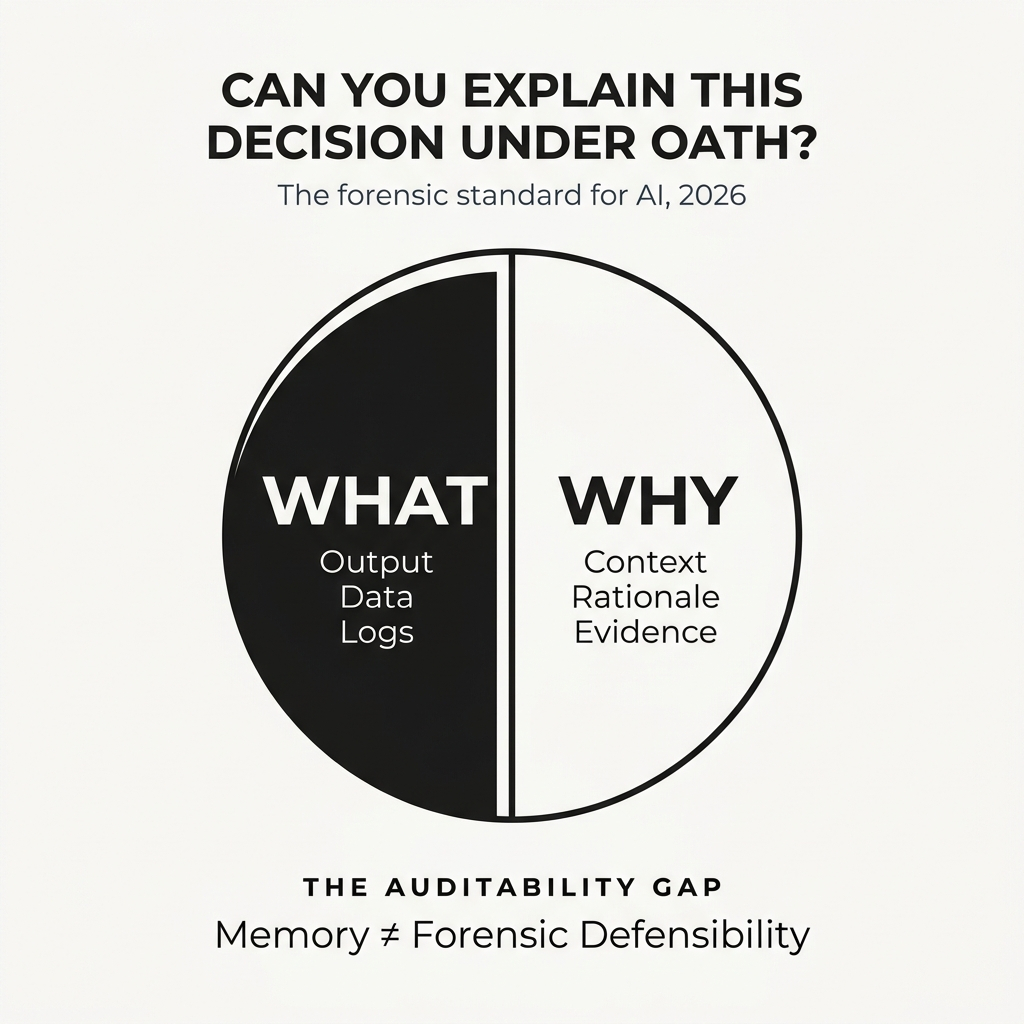
I've watched organizations lose millions because they couldn't answer a simple question: why did you decide that?
Not what did you decide. Not what was the outcome. Why.
The decision was made. The system executed. The output was delivered. But the reasoning that connected input to action disappeared the moment the session closed.
What's left is a black hole where accountability should be.
Auditability is not memory
Most people treat auditability like a storage problem. Keep the data. Archive the logs. Maintain the records.
That's memory. Memory is necessary but insufficient.
Auditability is the ability to reconstruct the complete rationale behind a decision. That includes the context that shaped it, the information that informed it, the back-and-forth that tested it, and the evidence that made it trusted.
Without those components, you have an artifact with no lineage. You can point to the output, but you can't defend how you arrived there.
In 2026, that gap carries material risk.
The legal standard has shifted to forensic defensibility
The benchmark for AI explainability is no longer theoretical. It's forensic.
Can you explain this decision under oath?
If your answer is "the algorithm did it," you've already failed. Regulators and courts treat AI as an extension of your organization's decision-making power, not as an independent entity you can blame.
The SEC made this explicit in their 2025 guidance on AI in financial services. Registered entities must be able to reconstruct the complete decision chain for any material action taken by an automated system.
That means data inputs, model state, decision logic, and human oversight touchpoints that contributed to the final outcome.
This isn't about storing outputs. It's about capturing the entire decision genome.
What the decision genome actually contains
A complete audit trail captures more than most systems are designed to record.
Context. What was happening when the decision was made? What constraints were active? What information was available versus what was assumed?
Most systems log the request and the response. They don't log the state of the world at the moment of execution.
Interaction history. What questions were asked? What options were considered and rejected? What did the agent surface, and what did the human override?
The back-and-forth between human and system is where reasoning happens. If you don't capture that exchange, you lose the logic.
Information provenance. What sources informed the decision? What data was used, and where did it come from? What version of the model was active?
General-purpose AI shows a 50-90% citation failure rate in compliance contexts. The output might be correct, but you can't trace it back to a defensible source.
Evidence chain. What made this decision trusted? Was there human review? What checks were applied? What approvals were required?
Trust isn't inherent. It's constructed through verification. If you can't show what verification happened, the trust is unearned.
Human intervention. If someone overrode the system, that action must be logged. If a compliance analyst rejected a model recommendation, you need to know why.
Auditability must cover both AI decisions and human interventions. Both are part of the decision chain.
Manual reconstruction is now treated as a control failure
If you have to reconstruct the audit trail manually after the fact, your controls failed.
That's the regulatory position in 2026.
Audit trails must capture data usage, model versions, approvals, overrides, and monitoring actions without manual intervention. AI-driven processes must generate traceable evidence as part of execution.
Without that, you can't demonstrate compliance. You can't support audit requirements. You weaken your defensibility.
The expectation is that the system itself produces the proof, not that someone assembles it later from scattered logs.
The black box problem carries material business risk
For financial institutions, lack of transparency is not a technical issue. It's a critical business risk.
It leads to regulatory penalties, financial losses, and erosion of stakeholder trust.
Machine learning systems are black boxes by nature. They cannot answer what happened, how it happened, or why it happened to the user.
This inability shakes stakeholder and investor confidence. It increases the cost of improving the system. It raises risk.
The EU AI Act brings penalties up to €35 million for non-compliant high-risk AI systems. The transparency provisions take effect in August 2026.
Enterprise-grade explainability requires five capabilities most platforms lack: training data attribution, influence scoring, complete audit trails, contestability, and model certification.
Explainability is a control architecture, not a model feature
Explainability is better understood as a control architecture for enterprise AI systems.
It spans model behavior, internal mechanisms, user trust, provenance, and end-to-end auditability.
The organizations that will lead on AI over the next two years will not be the ones with the prettiest explanation dashboards.
They will be the ones that can answer, with evidence, three hard questions: what happened, why it happened, and what they can do about it.
That requires infrastructure. Not documentation. Not post-hoc analysis. Infrastructure that captures the decision genome as the decision is being made.
What I've built to close the gap
I've engineered a constitutional AI governance model that treats auditability as substrate, not as an add-on.
It's called the CHARTER → NOMARK → CLAUDE → SOLUTION → PRD → PROGRESS stack.
Each layer enforces independence properties, tamper-evidence structures, and complete traceability from constitutional instruction through to executed outcome.
The system doesn't just log what happened. It captures why it happened, what context shaped it, what evidence supported it, and what human oversight was applied.
This is buildable infrastructure for regulated industries that need to demonstrate compliance, defend decisions under audit, and maintain trust with stakeholders.
It's designed for organizations that understand auditability is not memory. It's the engineered capability to reconstruct the complete decision rationale, including all context, interactions, and evidence.
The cost of the void
When you can't explain what happened, you lose more than defensibility.
You lose the ability to learn from the decision. You lose the ability to improve the system. You lose the ability to trust the output.
The void that opens when auditability fails is not just a compliance gap. It's a capability gap.
Organizations that treat auditability as infrastructure will move faster, operate with more confidence, and defend their decisions with evidence.
Organizations that treat it as a documentation problem will continue to lose millions answering questions they should never have been asked.
The gap between those two positions is growing.