The oversight vacuum: why AI adoption without governance is tearing companies apart

I've watched the same pattern repeat across dozens of organizations in the past 18 months. A leadership team sees a demo. Someone in the room plays with ChatGPT over lunch. The conversation shifts from "should we" to "how fast can we" in a single meeting.
The deployment begins before anyone checks what's actually under the hood.
This isn't a story about technology moving too fast. This is about organizations moving faster than their ability to understand what they're deploying. The gap between adoption and oversight has become the defining risk of enterprise AI implementation in 2025.
And it's splitting companies down the middle.
The hype capture is complete
The numbers tell the story more clearly than any boardroom presentation. 70 to 85 percent of AI projects fail to meet expected outcomes. Despite $30 to 40 billion in enterprise GenAI investment, 95 percent of organizations are achieving zero measurable return.
The percentage of companies abandoning the majority of their AI initiatives before they reach production has surged from 17 percent to 42 percent year over year.
Organizations are reporting that 46 percent of projects are scrapped between proof of concept and broad adoption.
This isn't a technology problem. This is a due diligence problem.
The pattern is consistent. Leadership sees the potential. The pressure to move builds. Time becomes the constraint. The evaluation process that would normally take months gets compressed into weeks or days. The question shifts from "what are the risks" to "how do we not fall behind."
The result is deployment without understanding. Adoption without architecture. Integration without governance.
You end up with AI in production and no one who can explain how it works, what it's doing, or what happens when it fails.
The organizational split
What happens inside the organization when AI arrives without a governance layer is predictable.
Two groups form immediately.
The first group sees the risk. They've read the headlines about hallucinations, bias, data leaks. They know the technology is powerful and they know powerful things break in expensive ways. So they freeze. They don't touch it. They wait for someone else to figure it out. They stay paralyzed while the rest of the organization moves forward.
The second group sees the opportunity. They're the early adopters. They experiment. They integrate AI into their workflows. They get the productivity bump. Then the model hallucinates. It fabricates a citation. It makes up a customer interaction. It produces something confidently wrong and they don't catch it until it's already caused damage.
The trust collapses.
Both groups end up in the same place. The cautious group never started. The optimistic group started and stopped. Neither group is extracting value. Neither group has oversight.
The data confirms this split is material. A 2026 survey found that 54 percent of C-suite executives admit that adopting AI is tearing their company apart. Trust in AI companies dropped from 61 percent to 53 percent globally in 2024. In the United States, trust declined 15 points from 50 percent to 35 percent.
29 percent of employees admit to sabotaging their company's AI strategy. That number rises to 44 percent for Gen Z workers.
73 percent of CEOs report stress or anxiety from AI. 64 percent fear losing their jobs over AI transition failures.
This isn't friction. This is fracture.
The reliability crisis no one is measuring
The technical problem at the center of this organizational split is straightforward. AI models hallucinate. They produce incorrect outputs with complete confidence. They don't trigger alerts. They don't throw errors. They just lie.
77 percent of businesses express concern about AI hallucinations. 47 percent of enterprise AI users made at least one major decision based on hallucinated content in 2024.
The issue is not that the technology is unreliable. The issue is that the unreliability is invisible until it causes damage.
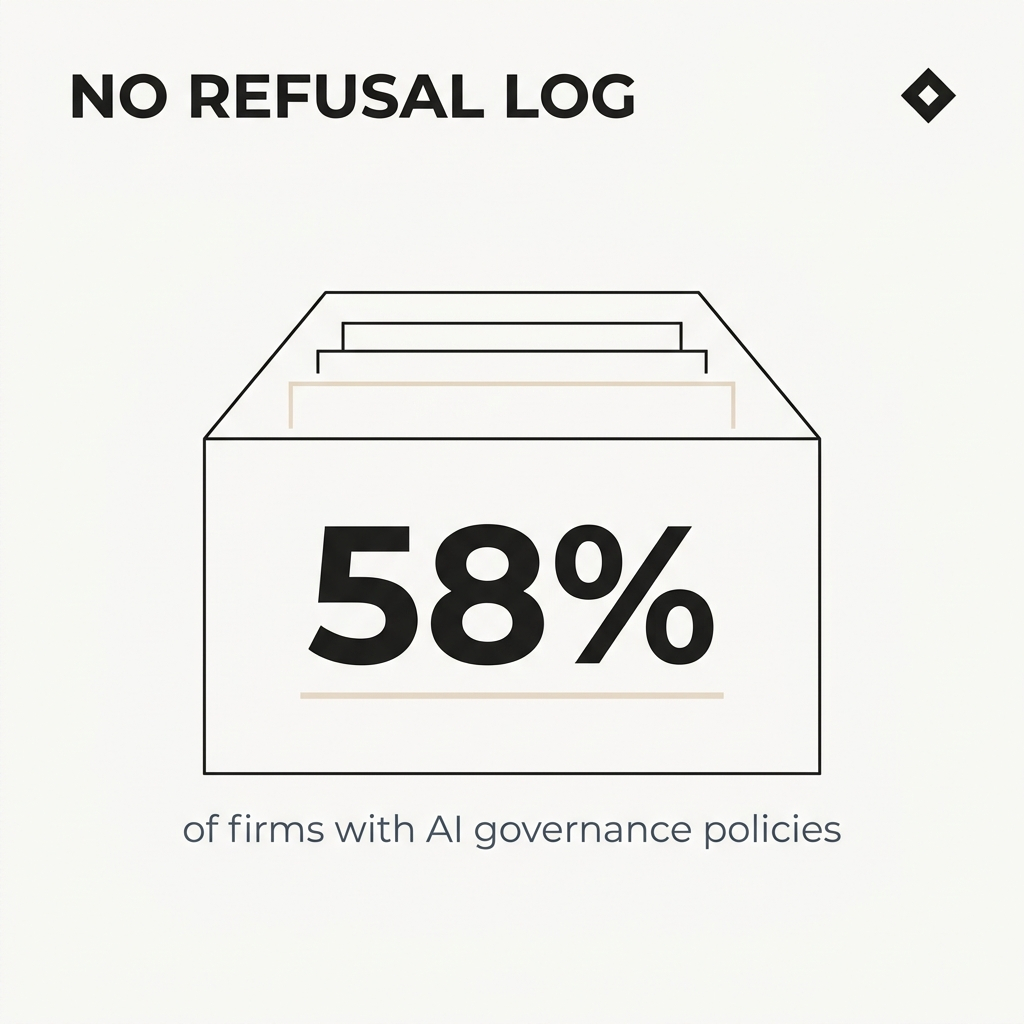
You can't govern what you can't see. You can't oversee what you can't measure. And most organizations have deployed AI without the instrumentation required to detect when the model produces something false.
The result is a reliability crisis that only surfaces after decisions have been made, documents have been published, or commitments have been issued based on fabricated information.
The oversight gap isn't just a governance failure. It's a structural defect in how AI is being integrated into enterprise operations.
The ROI disaster hiding in plain sight
The financial reality of AI adoption without oversight is becoming impossible to ignore.
McKinsey's November 2025 survey found that over 80 percent of organizations report no meaningful enterprise-wide EBIT impact despite AI adoption. The IBM Institute for Business Value found that enterprise-wide AI initiatives achieved an ROI of 5.9 percent despite incurring a 10 percent capital investment.
Most respondents reported achieving satisfactory ROI on a typical AI use case within two to four years. That's significantly longer than the typical payback period of seven to 12 months expected for technology investments. Only six percent reported payback in under a year.
The capital is being deployed. The value is not being realized.
The explanation is not complicated. You cannot extract value from a system you do not understand. You cannot scale a capability you cannot govern. You cannot measure ROI on outcomes you cannot verify.
The oversight vacuum doesn't just create risk. It destroys value.
Organizations are investing billions into AI deployment and getting nothing back because they skipped the step where they build the governance infrastructure required to make the technology productive.
The disclosure wave is coming
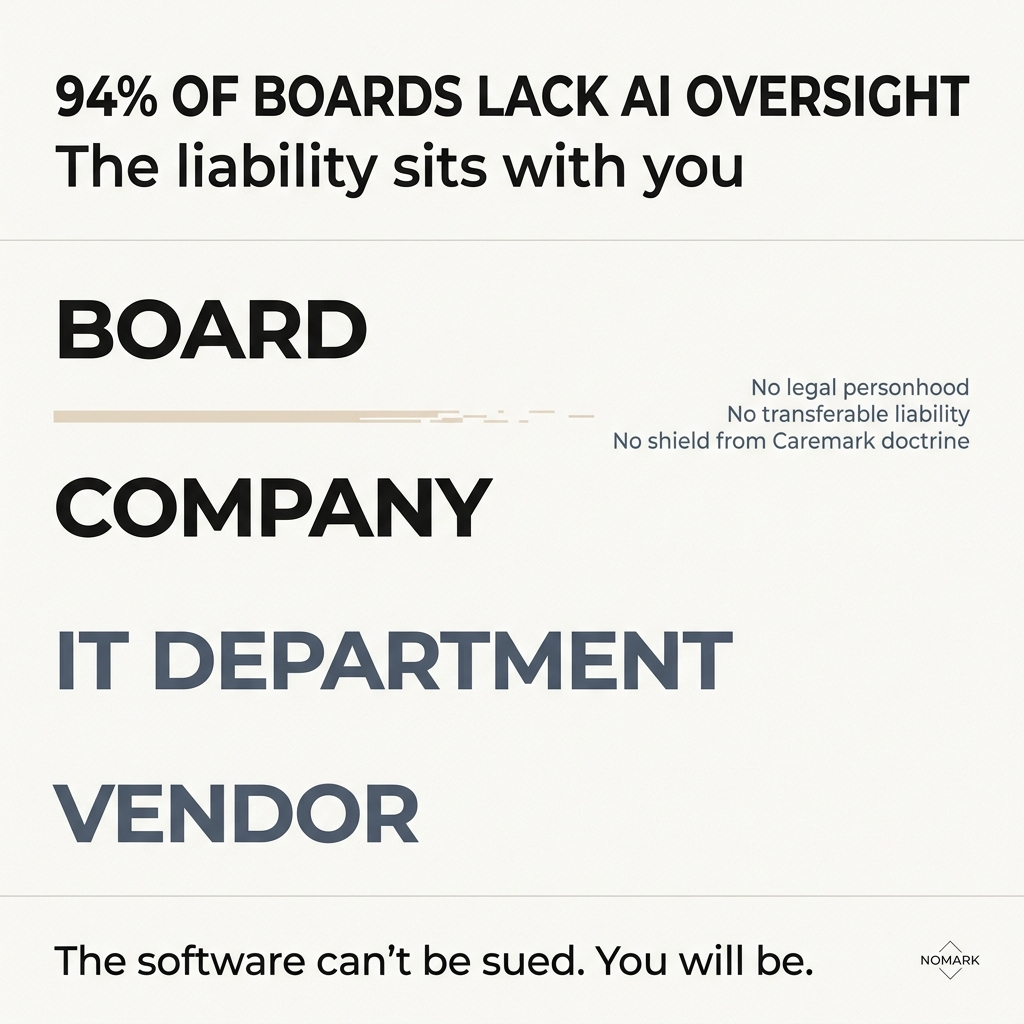
The boardroom has started to notice.
72 percent of S&P 500 companies disclosed at least one material AI risk in 2025. That's up from just 12 percent in 2023.
This represents a six-fold increase in acknowledged AI risk in two years.
The market is beginning to recognize that AI deployment without oversight is not just an operational issue. It's a material enterprise risk requiring disclosure.
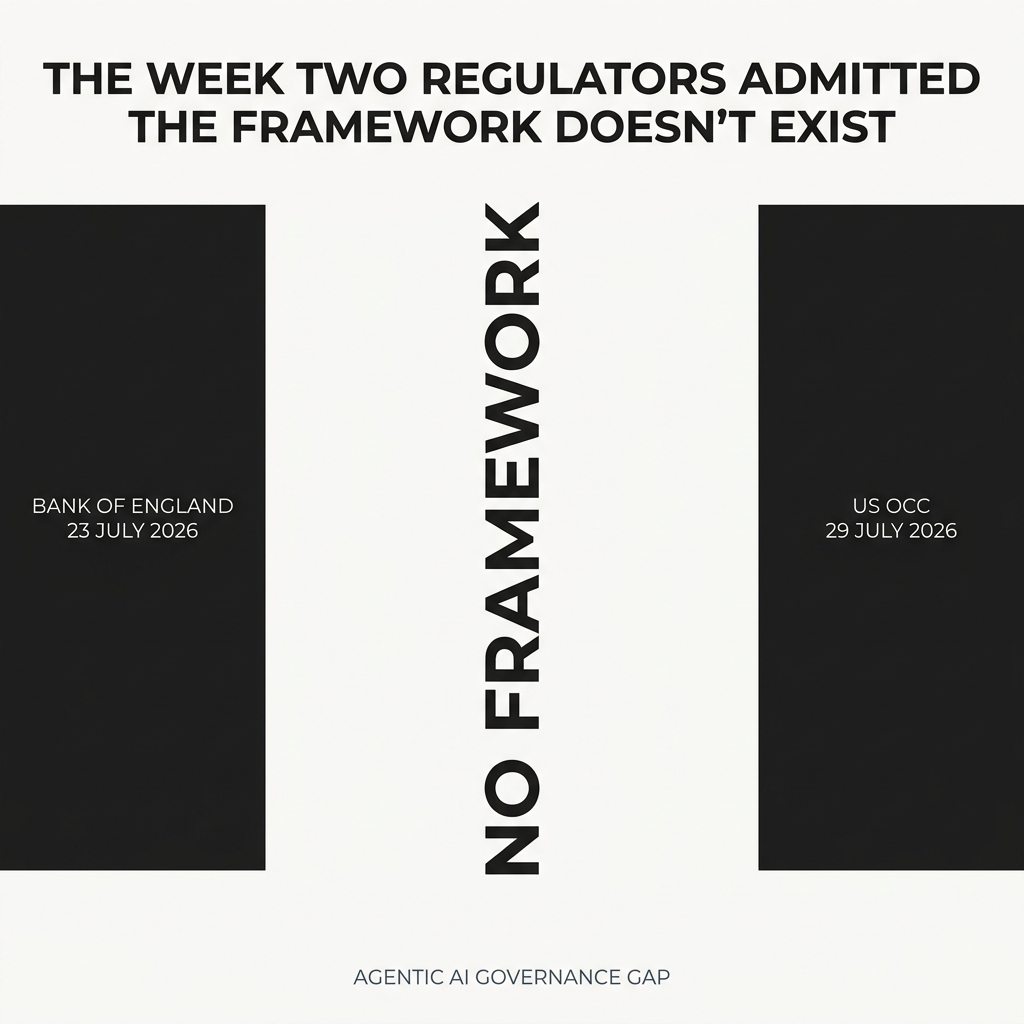
The regulatory pressure is building. The legal exposure is growing. The reputational damage from AI failures is becoming harder to contain.
The organizations that moved fast without governance are now facing the consequences. The ones that haven't moved are facing a different problem. They're paralyzed by the risk they've watched others create.
Neither position is sustainable.
The performance theater replacing strategy
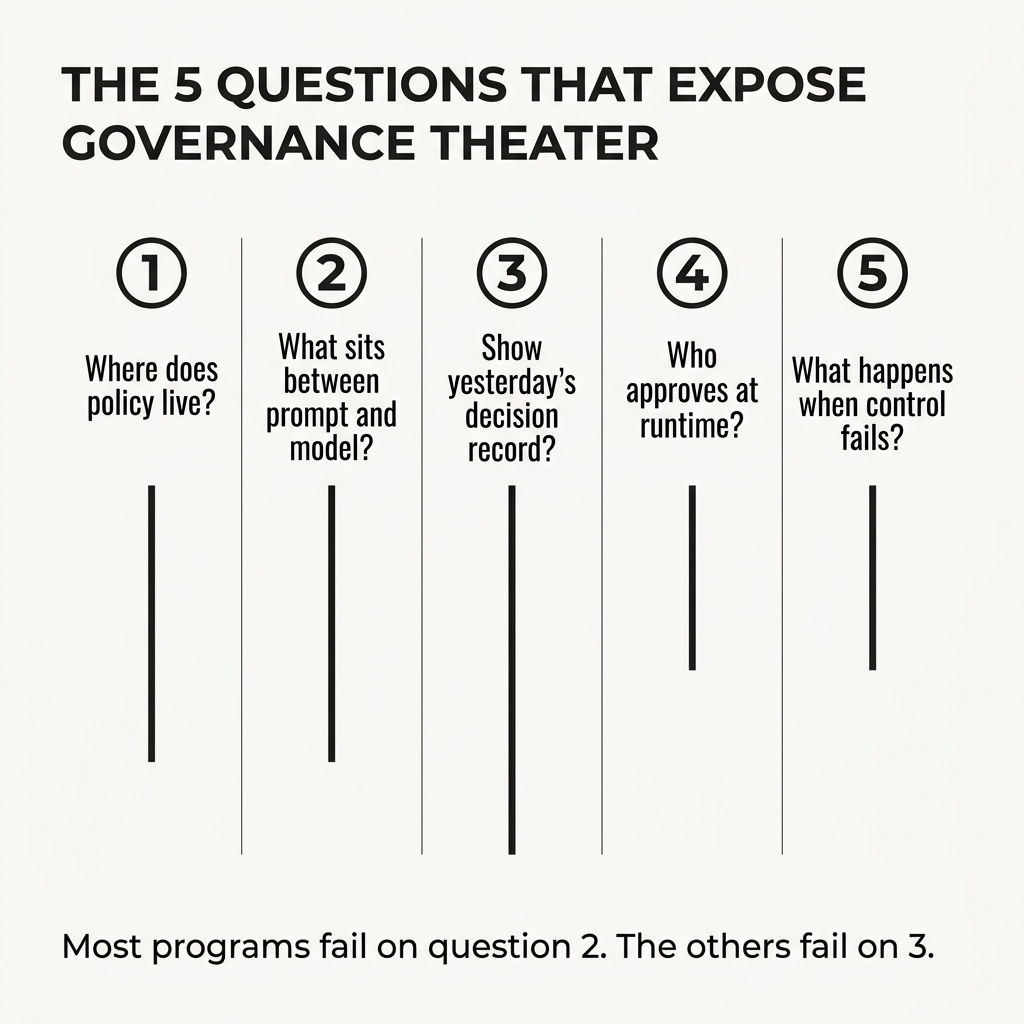
Under pressure to show progress, organizations have started performing AI adoption instead of executing it.
75 percent of executives admit their company's AI strategy is more for show than actual internal guidance. Nearly half call AI adoption a massive disappointment. That number is up from 34 percent last year.
Few are reporting significant ROI from generative AI (29 percent) or AI agents (23 percent).
The pattern is clear. Time pressure eliminates due diligence. The need to demonstrate progress replaces the need to deliver outcomes. The strategy becomes a document instead of a system.
The result is AI in production without governance, oversight, or measurable value.
This is not a temporary phase. This is the new baseline for enterprise AI adoption. Organizations are deploying technology they do not understand, cannot govern, and are not extracting value from.
The oversight vacuum is not a gap that will close on its own. It's a structural defect that requires intentional correction.
What happens next
The organizations that survive this phase will be the ones that stop moving and start building.
They will stop deploying AI as a response to hype and start deploying it as a response to specific, measurable problems.
They will build governance infrastructure before they scale adoption. They will instrument their systems to detect hallucinations, measure outcomes, and verify reliability before those systems touch production workloads.
They will treat AI as a capability that requires oversight, not as a product that can be purchased and deployed.
The ones that don't will continue to experience the organizational split, the reliability failures, the ROI disasters, and the disclosure pressure.
The oversight vacuum is not a temporary condition. It's the defining characteristic of enterprise AI adoption in 2025.
The companies that recognize this and correct for it will extract value. The ones that don't will continue to burn capital and fracture their organizations while wondering why the technology isn't delivering what was promised.
The answer is simple. You deployed AI without understanding it. You adopted it without governing it. You scaled it without measuring it.
The oversight vacuum is not an accident. It's a choice.
And it's a choice that's costing you more than you know.