Most companies aren't using AI. They're performing it.


TL;DR: Organizations buy AI without defining what success looks like. They deploy tools, run pilots, create governance frameworks, but skip the step of connecting technology to measurable outcomes. The result is expensive theater that produces activity without results.
Why most AI initiatives fail:
- No measurable outcome defined before deployment
- Procurement processes designed for deterministic software, not probabilistic AI
- Missing translation layer between technical capability and business strategy
- Governance treated as policy documentation instead of engineered infrastructure
- Metrics measure activity (adoption, queries processed) instead of outcomes (business results)
The pattern repeats everywhere
Organizations buy AI tools the way they bought enterprise software in 2005: because competitors are doing it, because boards are asking about it, because fear of being left behind outweighs the discomfort of not knowing why.
The procurement happens fast. The implementation drags. The results never materialize because no one defined what results would look like before the contract got signed.
Three patterns recur:
Tool-first adoption. A department head reads about GPT-4 or Claude, gets excited, buys licenses for the team. Six months later, usage sits at 12% and no one names a process that improved. The tool sits there, expensive and unused, because no one connected it to an outcome before deployment.
Innovation theater. Leadership announces an AI transformation initiative. A steering committee forms. Consultants get hired. Slide decks multiply. But the work never moves from strategy documents into operational reality because no one removed the assumptions about what AI does in their environment with their constraints.
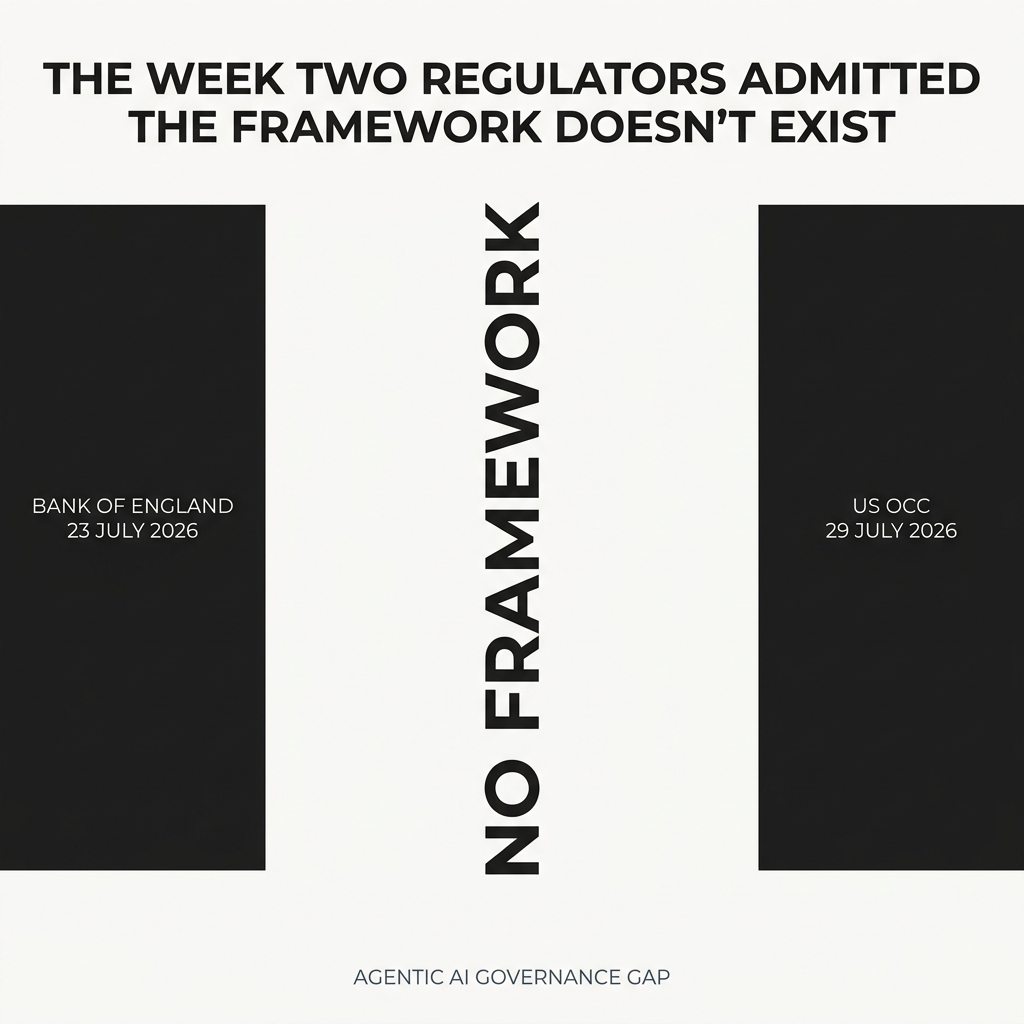
Compliance-driven deployment. Regulators start asking questions about AI governance. The organization scrambles to show they have an AI strategy. They produce a framework document, stand up a review board, but there's no substrate underneath. No one built the evidence structures, the independence properties, or the constitutional reasoning that would make governance auditable. A document, not a system.
All three patterns share the same structural defect: activity without outcome definition.
Key point: Organizations are deploying AI based on competitive pressure and board questions, not defined business outcomes. The activity looks like strategy but produces no measurable results.
Why this keeps happening
The gap isn't technical. It's strategic.
AI arrived faster than the frameworks for evaluating it. Companies that spent decades learning how to assess ERP systems or CRM platforms suddenly faced a technology category that doesn't fit the old evaluation models. They defaulted to what they knew: buy the tool, figure out the use case later.
That approach worked when software was deterministic. You could spec requirements, build to spec, verify the output matched the input. AI doesn't work that way. The output is probabilistic. The value is contextual. The risk profile changes based on deployment method.
Procurement processes didn't adapt. Budget cycles didn't adapt. Governance structures didn't adapt. Organizations are trying to buy AI the way they bought SAP in 2005, and wondering why it's not working.
The second issue is talent. Most companies don't have people who translate between business strategy and AI capability. They have technologists who understand models and business leaders who understand outcomes, but few people who stand in the middle and say: here's what this technology does in your regulatory environment with your data quality and your operational constraints.
Without that translation layer, you get two failure modes: over-promising (we'll use AI to change everything) or under-utilizing (we'll use AI for basic automation and call it innovation).
Neither produces the outcome the organization needs.
Key point: The problem isn't technology or talent in isolation. Organizations lack the strategic framework to evaluate probabilistic systems and the translation layer to connect AI capability to business outcomes.
What strategy looks like
Real AI strategy starts with the outcome and works backward.
Not "we need an AI strategy." You need a strategy for achieving specific business outcomes, and AI might be one tool in that strategy. You don't know until you define the outcome first.
The sequence that works:
1. Define the outcome in measurable terms.
Not "improve customer service." That's not measurable. "Reduce average handle time by 18% while maintaining CSAT above 4.2" is measurable. You verify whether it happened.
2. Remove assumptions about how to get there.
Most strategies fail because they're built on inherited beliefs about what's possible. Strip those out. Look at the constraints: regulatory requirements, data quality, system dependencies, team capability. What's true, versus what people believe is true.
3. Design the system that produces the outcome.
AI might enter the picture here. Not as the strategy itself, but as one component in a system designed to deliver a specific result. You're not deploying AI. You're building a system that happens to use AI because that's the most effective way to achieve the outcome you defined.
4. Execute with verification built in.
Deploy in stages. Measure at each stage. Verify the outcome is moving in the direction you predicted. If not, stop and diagnose why. Don't keep building on top of something that isn't working.
5. Measure what matters, not what's easy.
Most AI metrics are vanity metrics: number of queries processed, user adoption rate, models deployed. Those numbers tell you nothing about whether the outcome improved. Measure the outcome directly. If you don't measure it, you didn't define it clearly enough in step one.
This sequence forces clarity. It exposes when someone buys AI because it's fashionable versus because it solves a defined problem. It prevents the most common failure mode: spending money on technology that never connects to business value.
Key point: Strategy means defining measurable outcomes first, removing inherited assumptions second, then designing systems where AI is a component, not the objective.
The governance gap
Organizations that define outcomes clearly hit a wall when they try to govern AI systems.
Traditional governance assumes you audit the logic. You trace a decision back through the code and verify it followed the rules. AI systems don't work that way. The decision path isn't deterministic. You don't audit the logic because the logic is probabilistic and contextual.
Organizations do one of two things: they avoid deploying AI in regulated contexts (which eliminates most high-value use cases), or they deploy anyway and hope the regulator doesn't ask hard questions.
Neither approach works long-term.
What works is building governance as infrastructure, not as policy. You need tamper-evident logging. You need independence properties that prove the AI system won't be manipulated after the fact. You need constitutional reasoning embedded in the system architecture, not bolted on afterward as a compliance checklist.
This requires engineering, not policy writing. Most organizations don't have the capability to build it, and most vendors don't sell it because it's harder to package than a dashboard.
Without it, you don't deploy AI in any context where decisions need to be defensible. And if you don't deploy it in high-stakes contexts, you're limited to low-value use cases that don't justify the investment.
Key point: Governance fails when treated as policy documentation. It works when engineered as tamper-evident infrastructure with constitutional reasoning embedded in the system architecture.
What separates winners from performers
The organizations that figure this out will separate from those that don't.
Right now, most companies spend similar amounts on AI and get similar results: not much. That equilibrium won't hold. The firms that build real strategy, that connect AI deployment to measurable outcomes, that engineer governance as substrate instead of performing it as theater, those firms will see returns their competitors can't match.
The gap will widen fast. Not because AI itself is competitive advantage, but because the capability to deploy it strategically is rare. Once you have that capability, you move faster than organizations still trying to figure out what problem they're solving.
The work isn't buying better tools. The work is building the operating model that turns tools into outcomes. Not a vendor problem. An internal capability problem.
Most organizations haven't started building it yet.
If you're trying to figure out your AI strategy by copying what other companies announce in press releases, you're already behind. The companies winning this aren't talking about AI. They defined the outcome, removed the assumptions, built the system, and measured whether it worked.
Everything else is performance.
Frequently asked questions
What makes an AI strategy different from a technology strategy?
AI strategy isn't a category. You need a strategy for specific business outcomes where AI might be one tool. The difference is starting with the outcome and working backward, not starting with the technology and looking for problems to solve.
How do I know if my organization needs AI?
Define the measurable outcome first. Then strip out assumptions about how to achieve it. Look at your constraints: regulatory requirements, data quality, system dependencies, team capability. If AI is the most effective way to achieve that outcome within those constraints, you need it. If not, you don't.
Why do most AI pilots fail to scale?
Pilots succeed when the environment is controlled and the problem is simplified. They fail at scale because no one removed the assumptions about what works in production with real data quality issues, regulatory constraints, and operational complexity. The pilot proved the technology works in theory. It didn't prove the system works in reality.
What's the difference between AI governance and traditional IT governance?
Traditional governance audits deterministic logic. You trace decisions through code and verify they followed rules. AI governance requires tamper-evident infrastructure because the decision path is probabilistic. You need independence properties, constitutional reasoning embedded in architecture, and evidence structures that prove the system wasn't manipulated after the fact.
How long does it take to build real AI capability?
Building the operating model that connects AI deployment to measurable outcomes takes longer than buying tools but less time than running failed pilots. The sequence: define outcome (weeks), remove assumptions (weeks), design system (months), execute with verification (months), measure results (ongoing). Organizations that skip steps end up rebuilding from scratch.
What metrics should I track for AI initiatives?
Measure the business outcome directly, not the technology activity. Not queries processed or adoption rates. Those are vanity metrics. If you defined the outcome as reducing handle time by 18% while maintaining CSAT above 4.2, measure handle time and CSAT. If the outcome metric isn't moving, the initiative isn't working.
Do I need to hire AI specialists to build strategy?
You need people who translate between business strategy and AI capability. Not technologists who understand models in isolation, or business leaders who understand outcomes without technical constraints. You need the translation layer: people who say what this technology does in your regulatory environment with your data quality and your operational constraints.
What happens if I wait to develop an AI strategy?
The gap between organizations with real strategy and those performing innovation theater will widen fast. Not because AI itself is advantage, but because the capability to deploy it strategically is rare. Organizations that build this capability move faster than competitors still figuring out what problem they're solving. The equilibrium where everyone spends similar amounts and gets similar results won't hold.
Key takeaways
- Most organizations are performing AI strategy, not executing it. They deploy tools without defining measurable outcomes first.
- AI requires a different evaluation framework than deterministic software. Procurement, governance, and measurement systems built for ERP don't work for probabilistic systems.
- Real strategy starts with the outcome and works backward. Define what success looks like in measurable terms, remove inherited assumptions, then design systems where AI is a component.
- Governance fails as policy documentation. It works when engineered as tamper-evident infrastructure with constitutional reasoning embedded in system architecture.
- The competitive gap will widen between organizations that connect AI to outcomes and those that treat it as innovation theater.
- The work isn't buying better tools. The work is building the internal capability to turn tools into measurable business results.