If you can't name the fear, you're not ready for the tool

I've watched organizations rush AI deployment like it's a competitive sprint. The urgency is real. The preparation is not.
The conversation always starts the same way: "We need AI." I ask what they're trying to achieve. The answer is usually a category, not an outcome. "Efficiency." "Innovation." "Staying competitive."
These aren't drivers. They're placeholders for thinking that hasn't happened yet.
The diagnostic question most organizations skip
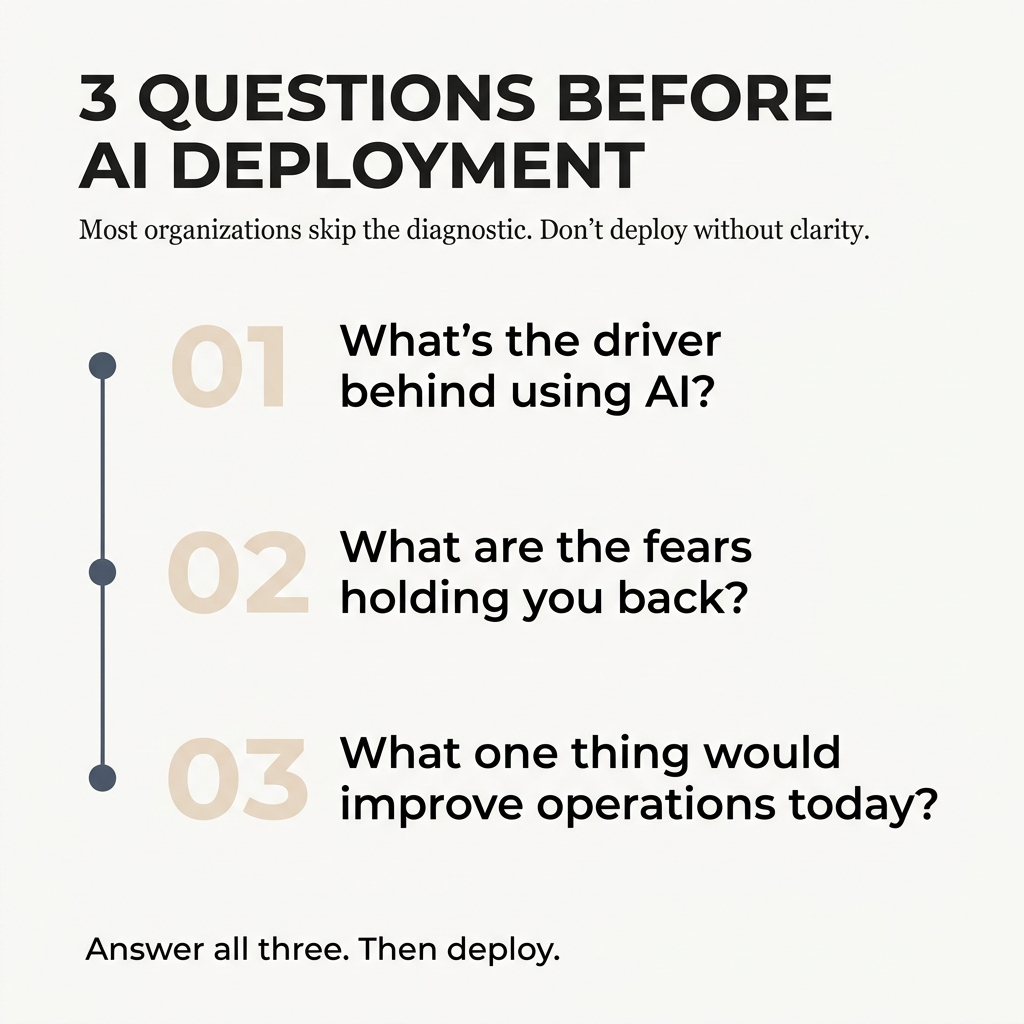
Before you touch the technology, answer three questions in sequence:
What's the driver behind using AI? Not the business case. Not the budget line. The actual problem you're solving or the capability you're building.
What are the fears? Job displacement. Loss of control. Data exposure. Regulatory liability. These aren't peripheral concerns. They're the primary barriers to adoption. Employee resistance shows up as the most frequently cited implementation barrier at 49%. Fear isn't irrational. It's diagnostic.
If you could implement one thing today to improve operations, what would it be? This forces specificity. It separates real need from ambient pressure to "do something with AI."
If you can't answer all three, you're not ready to deploy anything.
The data sensitivity rule nobody follows
Here's the operational test: if you wouldn't email it, don't put it in public AI.
Simple. Ignored constantly.
42% of enterprise data leaks in 2024 were traced back to public AI services. Approximately 18% of enterprise employees paste data into generative AI tools. More than half of those paste events include corporate information. The average is 3.8 pastes per day containing sensitive data.
This isn't a technology problem. It's a governance failure disguised as convenience.
You need to know what the AI is working on before you grant access. Not the category of work. The specific data types. Client information. Proprietary models. Regulatory filings. Code repositories.
The specificity matters because the risk profile changes completely based on what you're exposing.
Why organizations can't articulate their drivers
Only 22% of organizations have a visible, defined AI strategy. 40% are adopting AI without one.
That's not agility. That's reactive deployment under competitive pressure.
The organizations that do have strategies are twice as likely to see revenue growth from AI and 3.5 times more likely to achieve critical benefits. The gap isn't capability. It's clarity.
When I ask what someone is trying to achieve with AI, the vague answers aren't evasion. They're evidence that the diagnostic work hasn't been done. The organization hasn't separated the real problem from the perceived solution.
You can't prescribe the tool until you've diagnosed the human.
Governance isn't compliance theater
AI governance has shifted from policy statements to operational evidence. As of early 2026, 39% of organizations reported not consistently enforcing their AI usage policies.
That's the gap between having a document and having a system.
Governance isn't what you say you'll do. It's what you can prove you did. The constitutional architecture I build for regulated industries isn't commentary on best practices. It's tamper-evident substrate. Hash-chaining. WORM evidence structures. Independence properties embedded in the system, not bolted on afterward.
The organizations that treat governance as engineered infrastructure rather than policy documentation are 10 times more likely to pass independent audits. They're also four times more likely to report revenue growth.
The correlation isn't accidental. Governance done right is execution infrastructure. It removes ambiguity. It creates decision frameworks. It makes deployment faster, not slower.
The cost of skipping the diagnostic
79% of companies globally expect to incur "AI debt" from poorly implemented autonomous tools. The costs show up as money, lost time, and work that has to be undone.
This is what happens when you deploy without diagnosis.
You build on assumptions that turn out to be wrong. You create dependencies on tools that don't match the actual workflow. You expose data you didn't mean to expose. You trigger resistance you could have anticipated.
Then you spend more time unwinding the implementation than you would have spent diagnosing the problem correctly in the first place.
Speed without clarity isn't velocity. It's thrashing.
What readiness actually looks like
You're ready to deploy AI responsibly when you can state, without hedging:
The specific outcome you're building toward. Not efficiency. Not innovation. The measurable change in capability or reduction in friction.
The fears your team has about the deployment. Job displacement. Skill obsolescence. Loss of autonomy. Data exposure. Regulatory risk. Name them. Address them. Don't dismiss them.
The data classification of what the AI will process. Public information. Internal documentation. Client data. Regulated information. Each category has different exposure rules.
The enforcement mechanism for your usage policy. Not the policy itself. The operational proof that the policy is being followed.
If you can't state these four things clearly, you're not ready. And deploying anyway doesn't make you agile. It makes you reckless.
The governance question disguised as a business question
Every AI deployment conversation is actually a governance conversation.
What are we trying to achieve? That's a strategy question.
What are we afraid of? That's a risk question.
What data is the AI touching? That's a compliance question.
Can we prove we're following our own rules? That's an audit question.
You can't answer any of these by evaluating vendors or comparing feature sets. You answer them by diagnosing the human system before you prescribe the technological tool.
The organizations that do this work first don't just avoid AI debt. They deploy faster, with less resistance, and with outcomes that compound rather than create new problems.
The diagnostic isn't a delay. It's the foundation that makes everything else possible.
If someone can't tell you what they're trying to achieve or what they're afraid of, they're not ready to deploy AI responsibly. And no amount of vendor selection or pilot programs will fix that gap.
Start with the human. The technology is the easy part.